Trending Searches
The Conundrum of Cycling Categories: A Cyclist's Perspective
The cycling world, much like many other specialized domains, often presents a labyrinth of terminologies and classifications that can be perplexing even to seasoned enthusiasts. This article delves into a cyclist's firsthand account of navigating these intricate distinctions, specifically concerning the evolution and proliferation of bicycle categories, ranging from traditional road bikes to the more contemporary gravel and 'all-road' iterations. The narrative commences with the author's personal journey, highlighting a significant preference for on-road cycling, a choice influenced both by personal inclination and geographical constraints that limit access to diverse off-road terrains. He vividly recalls a period where his attempts at mountain biking, despite considerable physical prowess, were consistently thwarted by a lack of technical off-road skills, resulting in numerous tumbles. This early experience underscores the fundamental differences in riding demands between road and off-road disciplines, setting the stage for a deeper exploration into how these lines have become increasingly blurred in recent times.
Further into the discussion, the author pivots to an analytical perspective, examining the ongoing trend of new bicycle categories emerging within the market. He observes that even in competitive events, the boundaries between bike types are fluid, citing instances where cyclocross races have been won on adapted road frames, and gravel bikes have been modified to meet specific race regulations. This phenomenon raises pertinent questions about the true necessity and functional uniqueness of each category. The article posits that the industry's drive to continuously segment the market might be a strategic response to evolving consumer demands or, more cynically, a mechanism to encourage multi-bike ownership. This market dynamic, coupled with the inherent difficulty of distinguishing between subtly different bike designs, suggests a complex interplay of technological innovation, marketing strategies, and rider preferences that shape the contemporary cycling landscape.
The Evolving Landscape of Bicycle Types
The cycling industry has witnessed a remarkable expansion in bicycle categories, leading to a complex web of choices for riders. This proliferation is particularly evident in the off-road and multi-terrain segments, where distinctions between cyclocross, gravel, and 'all-road' bikes often appear nuanced and, at times, arbitrary. The author, primarily a road cyclist, shares an amusing yet insightful anecdote about his past attempts at mountain biking. Despite possessing a strong physique and the ability to generate significant power, his lack of technical off-road prowess consistently led to mishaps, illustrating the specialized skill set required for each discipline. This experience highlights a fundamental challenge for riders: matching their skills and intentions with the right equipment, especially when the lines between bike types become increasingly indistinct. The continuous emergence of new categories, such as 'all-road' bikes positioned between endurance road and racier gravel models, prompts a critical examination of whether these new classifications offer genuinely distinct riding experiences or merely cater to perceived market gaps.
This ongoing categorization trend in cycling raises important questions about innovation versus market strategy. The author notes that even professional competitions reflect this fluidity, with racers like Toon Aerts achieving success on modified road frames in cyclocross, and Lachlan Morton adapting a gravel bike for a race where such bikes are typically prohibited. These examples underscore the adaptability of existing designs and challenge the strict boundaries implied by specialized categories. Furthermore, the observation that flat-bar gravel bikes visually resemble old rigid mountain bikes, despite claims of fundamental differences, adds to the bewilderment. A cynical perspective suggests that the industry, post-pandemic, might be leveraging this categorization to encourage consumers to purchase multiple bikes, viewing each new category as an opportunity to expand sales. This approach creates a potentially confusing landscape for consumers, who must discern genuine technological advancements from marketing-driven distinctions. Ultimately, the quest for the 'perfect' bike for every conceivable scenario often leads to an overwhelming array of choices that may not always translate into a significantly different riding experience.
Personal Experience and Market Trends
The author's personal journey in cycling predominantly unfolds on paved roads, a preference shaped by both his disposition and the geographical limitations of off-road cycling opportunities in his region. He recounts a period where he earnestly attempted mountain biking, equipped with a powerful engine but lacking the nuanced skills required for challenging terrains. This combination invariably led to frequent falls, underscoring the critical importance of a balanced skill set that transcends mere physical strength in off-road disciplines. His reflections reveal a palpable sense of detachment from the intricacies of off-road riding, yet a keen observer's eye for the evolving market. The perplexing array of off-road bike categories—cyclocross, gravel, flat-bar gravel, and now 'all-road' bikes—becomes a central point of inquiry, highlighting the sometimes-thin distinctions between these models. The author questions the practical necessity of such specific classifications when, for instance, a cyclocross race can be won on a modified road frame, or a gravel bike can be adapted for events typically beyond its scope.
This observation leads to a broader critique of the cycling industry's marketing strategies, particularly in a post-pandemic landscape. The continuous introduction of new bike categories, from 'crit' bikes in the 2000s to the current debate between 'aero' and 'climbing' road bikes, suggests a pattern of segmenting the market. The author speculates that this trend might be a deliberate effort by manufacturers to encourage consumers to own multiple specialized bikes, thereby boosting sales. He points out the irony that some of these categories, like 'all-road' bikes fitting between endurance road and racier gravel, seem to target an incredibly narrow niche, suggesting that minimal adjustments to existing bikes (like tire pressure) could achieve similar results. This raises the question of whether these new categories represent genuine innovation or primarily serve commercial interests. The article humorously concludes with a friend's comment about needing a 'pothole bike' rather than a gravel bike, encapsulating the sentiment that sometimes the core utility and durability are more important than highly specialized, overlapping categories.
Related Articles
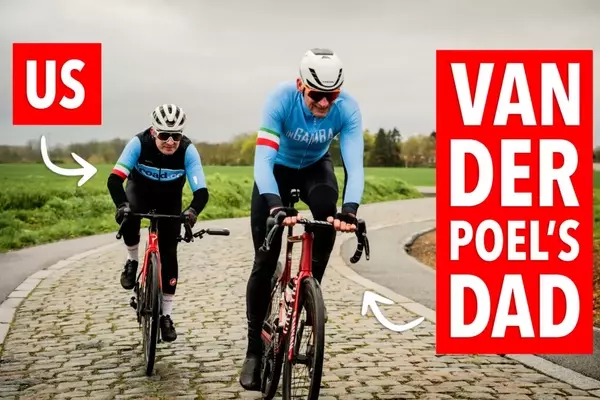
Navigating the Hell of the North: A Journalist's Cobblestone Ordeal with Adrie van der Poel

Alex Dowsett's Technical Deep Dive: Conquering Paris-Roubaix and the Cobbled Classics