Trending Searches
Cyclist Tadej Pogačar Faces Potential Driving Ban for Disregarding Red Light at Flanders Crossing
Tadej Pogačar, who recently triumphed in the Tour of Flanders, is under investigation and could face a driving suspension and significant financial penalty. This stems from an incident during the early stages of the Monument race where he, along with other cyclists, failed to stop at a railway crossing despite a red light. This act has been strongly condemned by the rail operator, Infrabel, for establishing a detrimental precedent. The public prosecutor's office in East Flanders is actively examining the situation, and it's anticipated that several riders will incur fines and potential driving bans for their actions.
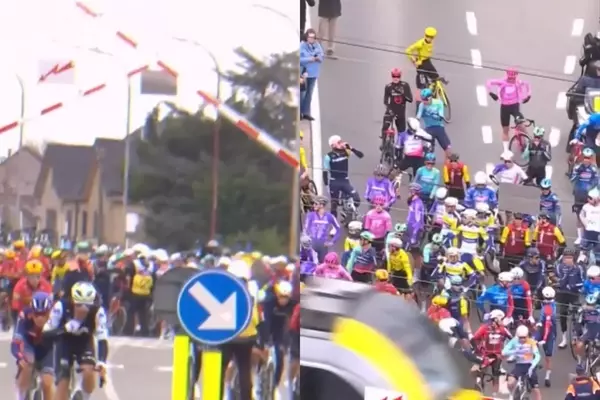
The contentious event unfolded at a railway intersection in Wichelen. The peloton unexpectedly divided as the crossing barriers descended to permit a train to pass. Pogačar and his UAE Team Emirates colleagues, positioned towards the front, had already navigated the crossing. Race officials subsequently halted these leading riders, allowing the trailing group to rejoin. However, the initial disregard for the red light by many front-of-pack cyclists has led to a formal inquiry.
Belgian reports indicate that the East Flanders public prosecutor's office intends to pursue legal action against the cyclists involved. A spokesperson for Infrabel emphasized the seriousness of the offense, stating, "Traffic regulations are clear: if the lights at a level crossing are on red, you must stop. That's the case in everyday life, and it naturally applies in a cycling race too." It's estimated that 20 to 30 riders could face fines ranging from €320 to €4,000, along with an eight-day driving prohibition.
Frédéric Petit from Infrabel highlighted the potential dangers of such conduct, noting that in everyday scenarios, these infractions carry severe consequences. He explained that normally, police or traffic control would coordinate with the rail operator to halt trains, preventing such an occurrence. The absence of such coordination resulted in the peloton's division, an outcome he explicitly called "not a good example."
Despite the uproar, the Union Cycliste Internationale (UCI) commissaires' post-race report made no mention of the railway crossing incident, and no riders were disqualified for it. Pogačar himself received a separate fine of 500 Swiss francs and a deduction of 25 UCI points, but this was for improper waste disposal, not for the red-light violation. The incident did, however, create a tactical disadvantage for UAE Team Emirates, as the breakaway group's lead extended significantly while the main peloton was delayed, forcing Pogačar's team to expend extra energy in pursuit.
Pogačar expressed his dissatisfaction with the situation, remarking, "It was not nice. I think they could prevent this by stopping us before, no? Not 10 meters before the crossing, three guys jump on the road. I was thinking, maybe it's like some protesters or something, like, something crazy is going on. And yeah, then the bunch was split from the crossing." Such train-related interruptions, while unusual, are not unheard of in professional cycling, a sport that often unfolds on public roadways. A notable similar event occurred at Paris-Roubaix in 2015, where riders blatantly ignored closed barriers, prompting the UCI to amend its rules to strictly prohibit crossing level crossings when warning signals are active. Cyclist Taylor Phinney was disqualified from the 2017 Tour of Britain for a similar offense. While race officials typically manage these situations to ensure fair play, the lack of such intervention in this instance remains a point of contention.
The Tour of Flanders incident involving Tadej Pogačar highlights a critical intersection of sports regulations and public safety laws. The ongoing investigation by the East Flanders public prosecutor's office into the disregard of a red light at a railway crossing underscores the importance of adherence to traffic rules, even in competitive environments. This situation serves as a reminder that athletes, regardless of their prowess, are not exempt from the legal frameworks designed to protect all citizens, and their actions can have significant legal and professional ramifications.
Related Articles

Redshift Unveils New Top Shelf Flat Riser Handlebar for Enhanced Mountain Biking Comfort and Accessory Mounting

Rudy Project Sinergy Helmet: An Eco-Conscious Choice with Practical Limitations