Trending Searches
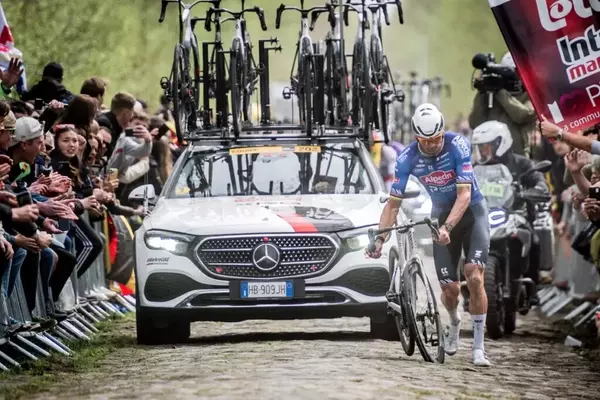
Innovations and Adaptations in Cycling Technology at Paris-Roubaix
Unveiling the Ingenuity: How Cycling Tech Conquers the Cobbles
The Evolution of Tire Width: Maximizing Grip and Comfort
The trend towards broader tires continues to gain momentum, with 35mm options becoming increasingly common. This shift is driven by the need for enhanced shock absorption and improved traction on the notoriously rough pavé. While 30mm tires once seemed groundbreaking, advancements in frame design now accommodate even wider dimensions, reflecting a strategic adaptation to the race's unique demands. Notably, some teams employ mixed setups, with larger tires on the front for optimal handling and stability, and slightly narrower ones on the rear, balancing volume with acceleration dynamics.
The Dual Valve System: A Novel Approach to Puncture Protection
Tubeless tire systems, despite their advantages, can still cause anxiety among riders due to potential air loss on impact. A new solution gaining traction involves a dual valve mechanism, observed on teams like Lidl-Trek. This system incorporates an internal tire insert, akin to an extra TPU tube, designed to prevent 'burping' (sudden air loss) and provide rim protection. It also offers a 'run-flat' capability, allowing riders to continue even after a puncture, a critical advantage in a race where mechanical failures can be decisive.
Single Chainrings: A Simplified Yet Effective Drivetrain Strategy
The adoption of 1x drivetrains, characterized by a single front chainring, has become a prominent feature in Paris-Roubaix. This setup simplifies gear changes and reduces the risk of chain drops on bumpy surfaces. Teams are employing various methods to implement this, from readily available gravel-specific groupsets like SRAM's XPLR to more improvised solutions. Shimano-backed teams, for instance, have experimented with mountain bike rear derailleurs for their superior chain retention, demonstrating a willingness to prioritize functionality over strict adherence to road cycling component hierarchies.
Prototype Components: Glimpses into Future Cycling Technology
The race also serves as a testing ground for unreleased cycling components. Teams such as Alpecin-Premier Tech were seen using prototype C60 wheelsets featuring carbon spokes, hinting at future innovations from manufacturers like Shimano. Similarly, new pedal designs were also in trial, with reports suggesting that differences in these prototypes even impacted riders' ability to swap bikes during the race, highlighting the subtle yet significant advancements occurring in cycling equipment.
The Champion's Choice: Simplicity Amidst Complexity
Despite the array of advanced and customized equipment, some riders opt for a more traditional, yet equally effective, approach. Wout van Aert, a past winner, chose a straightforward setup with a 54-tooth chainring and a standard road rear derailleur paired with a 10-28 cassette. This configuration emphasizes closely spaced gearing for optimal power transfer, illustrating that individual preferences and race strategy can dictate equipment choices as much as technological advancements.
Aero Dynamics: The Unwavering Pursuit of Speed
Even on the demanding cobbles, aerodynamic efficiency remains a crucial factor. Teams like FDJ deployed aero water bottles, underscoring the relentless pursuit of marginal gains. Deep-section wheels were also strategically used, and some teams even integrated aerodynamic gravel wheels into their setups, blurring the lines between different cycling disciplines in the quest for speed and stability.
Customizations and Cover-Ups: The Spirit of Roubaix Innovation
Beyond official sponsor equipment, riders and teams often resort to clever, unsanctioned modifications. Examples include using grip tape inside bottle cages to secure water bottles on rough terrain, and even blacking out tire logos or covering aftermarket chainrings with electrical tape to navigate sponsor obligations. These creative workarounds epitomize the pragmatic and ingenious spirit required to tackle Paris-Roubaix, where standard road bikes are often insufficient, necessitating extensive customization to conquer the 'Hell of the North'.