Trending Searches
Julian Alaphilippe's Illustrious Cycling Career and Enduring Legacy
Julian Alaphilippe's journey through professional cycling is a narrative of unwavering passion and captivating performances that consistently drew global admiration. Even as his career entered a phase marked by intense scrutiny over consistency and value for money, his ability to ignite excitement and stir emotions remained undiminished. His audacious and spontaneous approach to racing, particularly evident during an era often dominated by strategic, meticulously planned team tactics, set him apart and forged a deep connection with fans. This article explores key moments of his career, illustrating why he became, for many, the embodiment of cycling's thrilling unpredictability and a source of profound inspiration.
During the period when cycling was gradually recovering from the global pandemic, a series of documentaries began to chronicle the shifts in Julian Alaphilippe's performance levels. Concurrently, his former team manager frequently voiced concerns in interviews and columns regarding the financial investment in such a high-profile rider and the challenge of consistently justifying his salary. Yet, how does one quantify the intangible excitement and fervor that Alaphilippe evoked? His magnetic appeal was not easily captured by statistics or financial metrics; it resided in the sheer spectacle of his efforts on the bike.
It was a poignant coincidence that on the very day Alaphilippe officially concluded his racing career, the Women's Tour of Britain visited the site of one of his most legendary, albeit ultimately unvictorious, exploits. On the challenging ascent of the Great Orme, he pushed his physical limits in a valiant attempt to distance Wout van Aert, only to be narrowly beaten at the finish line in Llandudno. The image of him collapsing in exhaustion beside his rival underscored the immense effort. This particular attack, though not leading to a win, is remembered as a highlight in British cycling history, given Alaphilippe's previous achievements and Van Aert's subsequent dominance.
By this stage, Alaphilippe's distinctive style was well-established. He first gained prominence as a fearless stage-hunter, a striking contrast to the disciplined, often conservative racing strategies prevalent during the Team Sky era. While other teams prioritized aerodynamic efficiency and calculated maneuvers, Alaphilippe rode with a seemingly improvisational flair, constantly attacking and engaging. His versatility was remarkable: he could contend on demanding climbs and possessed the explosive power to succeed in sprints. And crucially, he carried the hopes of France.
Alongside figures like Peter Sagan, Alaphilippe brought much-needed vibrancy to Grand Tours that risked becoming predictable. His victories in races like Milan-Sanremo and multiple triumphs at La Flèche Wallonne were testament to his exceptional talent. However, it was in 2019 that he truly ignited a wave of patriotic passion across France. That year's Tour de France was anticipated to be a turning point, with established favorites aging and new stars yet to emerge. Many hoped for a French victory, with Thibaut Pinot and Romain Bardet seen as the primary contenders. Instead, Alaphilippe seized the spotlight. An early stage win, reminiscent of his Sanremo success, earned him the yellow jersey and several days in the lead. A thrilling two-man attack with Pinot on Bastille Eve further fueled national fervor.
The turning point arrived with a dramatic time trial in Pau, where Alaphilippe delivered an extraordinary performance in the yellow jersey, further elevating the hopes of his home nation. As Voeckler had fallen short in previous years, the question arose: could Alaphilippe maintain his lead? While romantics point to the landslides and shortened stages of the final week as cruelly snatching away his chance at overall victory, realists acknowledge the visible signs of fatigue and the toll of a race course that perhaps contained too many alpine challenges. Nevertheless, surviving with the general classification contenders until stage 19's Col de l'Iseran was an impressive feat for a rider who had also won a classic early in the season.
Despite his later career yielding impressive results on paper, including two World Championship titles and additional stints in the yellow jersey, Alaphilippe's reputation experienced a subtle cooling. These achievements satisfied journalists but did not reignite the same fervent, almost improbable belief among French fans as his 2019 Tour de France performance. As expectations continued to mount, he also faced a series of injuries and the arrival of his first child with Marion Rousse. Questions about his form intensified, compounded by a perceived loss of tactical acumen, as he often initiated attacks too early, expending energy before critical moments. This sometimes led to unforeseen outcomes, such as Tadej Pogačar's premature attack in a recent Amstel Gold Race, where the Slovenian was ultimately caught and defeated, a rare loss for him in one-day events.
In a more financially constrained environment, it became evident that his contract with Soudal Quick-Step would not be extended beyond 2024. Alaphilippe's absence from that year's Tour de France was framed diplomatically, with his stated goal of achieving Grand Tour stage victories at the Giro d'Italia. What followed was one of the most remarkable days of racing witnessed. On stage 12, characterized by undulating terrain perfectly suited to his style, he launched an attack with 138km remaining to join the breakaway. Just 12km later, he surged again, accompanied only by Italian wildcard Mirco Maestri. With the main peloton hot on their heels, the pair initially seemed destined to be caught. However, Alaphilippe ignored his Sports Director Davide Bramati's radio instructions to conserve energy. Instead, they defied expectations, with Maestri serving as a crucial shield and motivator, while Alaphilippe, in turn, spurred Maestri to unprecedented levels of performance. Recognizing their mutual reliance, Alaphilippe celebrated his sensational victory with Maestri, later exchanging jerseys and reflecting on their shared ordeal.
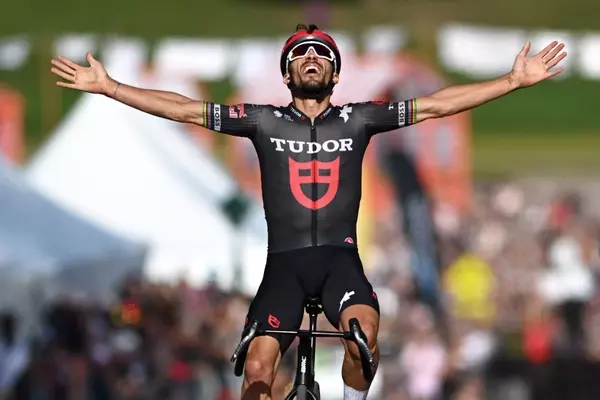
The transformation of Julian Alaphilippe from a cheeky rider who charmed the world with his playful demeanor alongside the French President to a mature athlete commanding the respect of his rivals is a testament to his growth. His performances in his final contract year were sufficiently strong to secure him a marquee signing with Tudor, and a victory in Canada along with a third-place finish in the Tour of Britain silenced many critics. However, his results in the current year lacked the same distinction. His last appearance at the Tour de France saw only two breakaway attempts, one of which was a doomed effort on the flattest stage of the race. Nonetheless, Alaphilippe remained a crowd favorite, drawing immense cheers from roadside fans, who, though his legs could no longer deliver the same explosive performances, offered him an outpouring of goodwill messages for his next chapter.