Trending Searches
Mastering Jack Crevalle Fly Fishing
Unleash the Power: Conquer Jack Crevalle with the Fly Rod
The Allure of the Jack Crevalle: A Thrilling Alternative to Giants
While exotic fishing expeditions for giant trevally often remain a distant dream due to substantial time and financial commitments, the Jack Crevalle presents an accessible and equally exhilarating alternative. These cousins of the mighty GT, though smaller in stature, reaching up to 40 pounds, are widely distributed across the Gulf and Southern Atlantic Coasts. They exhibit the same ferocious appetite for lures and flies, establishing themselves as one of the most tenacious inshore game fish in the United States.
Shifting Perceptions: From Nuisance to Prized Sport Fish
Historically, Jack Crevalle were often dismissed as undesirable due to their low culinary value. However, this perception is rapidly transforming, largely thanks to dedicated anglers like Zach Miller, a former Florida charter captain. As the angling community increasingly prioritizes the speed and strength of a catch over its edibility, the pursuit of jacks has surged in popularity year after year. While these fish can be found almost continuously throughout the year in various locations, Miller emphasizes early spring in South Florida as a prime period for targeting them.
Harnessing Nature's Force: The Influence of Wind on Jack Activity
Encountering a solitary Jack Crevalle is a rare occurrence; these fish are known for their schooling behavior, particularly during feeding frenzies. Witnessing vast expanses of agitated water, or what appears to be aquatic explosions, as a school of jacks hunts is an electrifying experience. Such events, though unpredictable, offer unparalleled excitement. For consistent action, Miller advocates for the early spring season in South Florida as an unbeatable time.
Miller elaborates that during spring, sustained southerly winds for several days prompt large numbers of jacks to move inshore from Central to South Florida. They converge within a few miles of the shoreline for spawning, forming schools that can span the size of football fields. Often, these schools are actively feeding, but they can also be found in transit, swimming just beneath the surface. In these scenarios, the challenge lies in anticipating their movement and presenting lures or flies precisely.
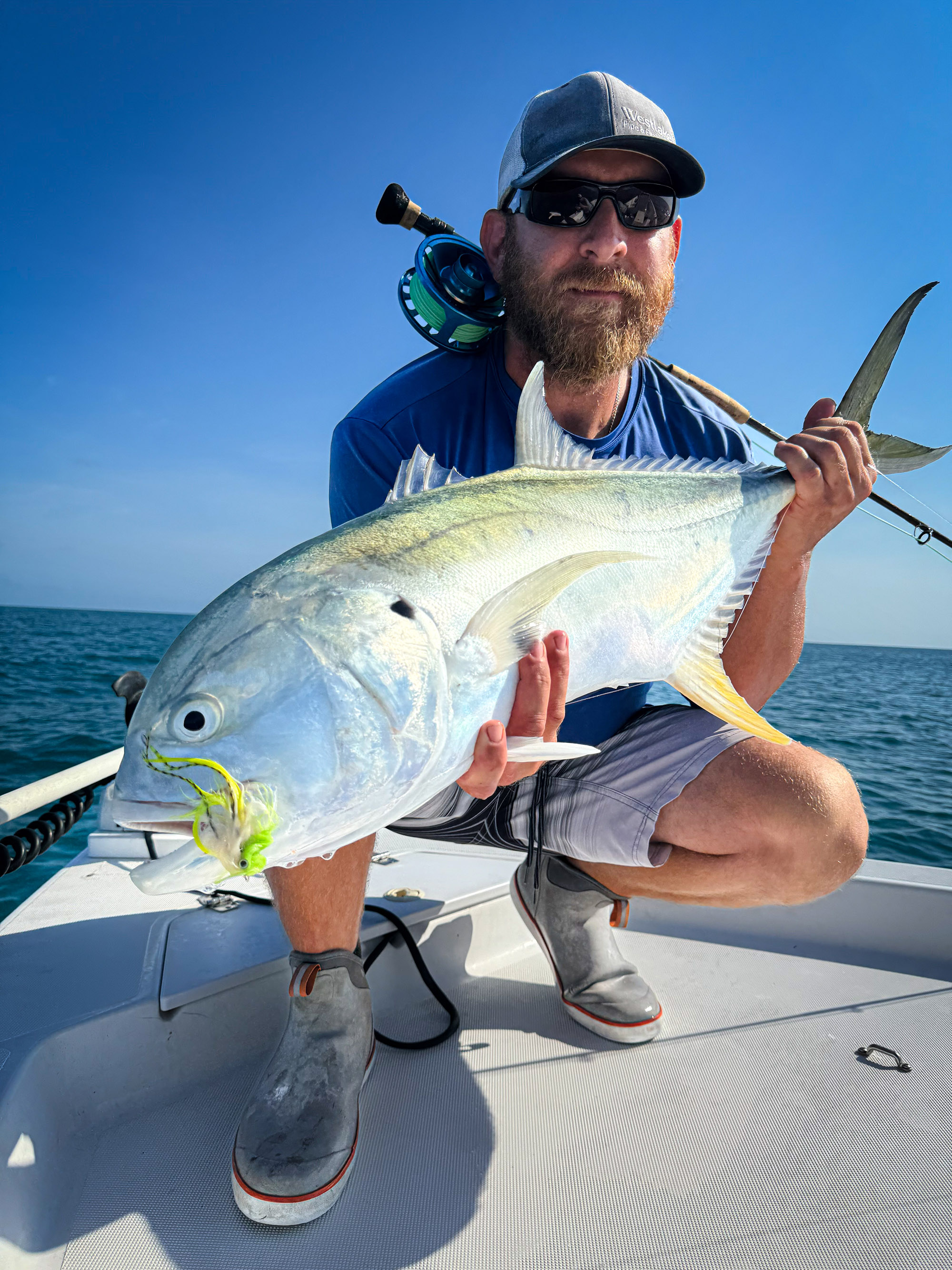
Miller advises that when using conventional gear with diving plugs, poppers, or metal jigs, the most effective method for eliciting a strike is to retrieve the lure through the school as quickly as possible. This illusion of escaping prey often triggers a predatory response from the fish, even if they are not in an active feeding frenzy. However, consistently enticing them with flies presents a distinct challenge.
Mastering the Art of Fly Presentation for Jack Crevalle
While Miller employs various tackle types for jacks, his true passion lies in catching them with a fly rod. This method is particularly well-suited for these fish, as their sheer numbers can sometimes lead to continuous hook-ups with conventional gear. While not inherently negative, dealing with treble hooks on each catch can become cumbersome. A fly rod, however, encourages a more deliberate approach, offers a unique fighting experience, and simplifies the release process with a single hook. Nevertheless, the technique for presenting a fly to a moving school requires precision and understanding.
Miller explains that when approaching a school of jacks, they typically exhibit one of two behaviors: either they are tightly grouped, circling like a vortex, or they are swiftly moving in a linear fashion. The specific behavior dictates the optimal setup. Many anglers attempt to position themselves ahead of the school, assuming the fish will swim into casting range. However, Miller notes that this often results in the fish diving or veering away just as they get close to the boat.
Miller favors targeting jacks that are "tornado-ing," as he describes their swirling behavior. Even if they are not actively feeding, he suggests that landing a fly approximately five feet from the nearest edge of the school will often provoke a fish to break away and strike. He also cautions against casting directly across the school, as the disturbance of the fly line tends to startle the fish or shut down their activity.
Equipping for Battle: Essential Gear for Jack Crevalle Fly Fishing
For targeting jacks, Miller typically utilizes an 11-weight fly rod and prefers floating line. Although lighter rods can manage Crevalle, a heavier setup significantly reduces fight time, a crucial factor given the propensity of sharks to prey on battling jacks. A reel with a robust drag system, capable of withstanding intense pressure, is also indispensable. Miller's preference for stout gear extends to the flies he deems most effective.
He asserts that "bigger is better" when it comes to flies. He routinely casts flies at least six inches long, frequently opting for those measuring 10 inches. When jacks are schooling in a circular pattern, a larger profile fly appears to more consistently trigger individual fish to break off and attack compared to smaller patterns.
Regarding fly patterns, Miller advises simplicity. Any fly that effectively imitates a larger baitfish, such as Cowen's Magnum in white, yellow, or chartreuse, will prove successful. In fact, Miller often ties his jack flies with minimal materials, recognizing that they are often shredded after just a few intense battles.