Trending Searches
The Quirks and Charms of Cycling Events
Cycling: Beyond the Obvious, Embracing the Absurd
The Asceticism of Everesting: A Peak of Impressiveness or Pointlessness?
Recently, the inaugural Everesting world championships captured attention. For those unfamiliar, Everesting entails repeatedly ascending and descending a single hill until the cumulative elevation gain equals the formidable height of Mount Everest—a staggering 8,848.86 meters. This gruelling endurance challenge saw Canadian rider Jack Burke and Britain's Illi Gardner emerge victorious in the men's and women's categories, respectively, completing their feats in approximately seven and a half and eight and a half hours. While undeniably a testament to human perseverance, this intense endeavor provokes a contemplative pause: is it a pinnacle of athletic achievement or a wonderfully eccentric pursuit?
From Scratch to Spectacle: Unravelling Cycling's Varied Formats
Considering the inherent simplicity of cycling as a sport, one might wonder about the proliferation of diverse race formats. Fundamentally, cycling can be distilled into two 'natural' forms: the scratch race, where all competitors start simultaneously, and the first to cross the finish line wins; and the time trial, an individual race against the clock. The multitude of other racing disciplines, particularly those witnessed on the track, often stem from the Victorian era's need to create engaging spectacles for ticket-paying audiences. This led to the invention of events like the Madison, team pursuit, and even races against ponies, highlighting a historical drive for entertainment over pure sporting essence. Even road races, with their often-scripted breakaways, demonstrate a complex, almost theatrical, layer beyond mere speed.
The Peculiarities of Athletic Pursuits: A Broader Perspective
The quest for diverse and engaging competitive formats isn't unique to cycling. Other sports exhibit similar curiosities. Swimming, for instance, features a variety of strokes beyond the most efficient, akin to cycling embracing unconventional riding styles. Athletics, too, showcases events involving throwing various objects or performing different types of jumps, such as the triple jump and keirin in track cycling, which stand out for their intricate and somewhat arbitrary rules. These examples underscore a broader human inclination to invent and adhere to specific, often elaborate, competitive structures that transcend simple contests of speed or strength.
Mountain Kings and Tricycle Dreams: Unconventional Rewards and Untaken Paths
Even established cycling competitions harbour their own quirks. The 'King or Queen of the Mountains' classification, intended to crown the best climber, frequently rewards riders adept at forming breakaways and possessing a modest sprint, rather than solely the most powerful ascenders. This suggests a disconnect between the intended recognition and the actual attributes rewarded. Reflecting further, the very first road race in 1869 included unicycles and tricycles, prompting a whimsical thought about an alternative history where 'how many wheels' became a central competitive variable. Perhaps, an elite men's road tricycle race or even unicycle Everesting represents a 'sliding-doors' moment, a road not taken that could have offered equally compelling, if not more outlandish, spectacles.
Tubercles: Enhancing Aerodynamics with Nature's Lumps
The term 'tubercle', derived from the Latin for 'small lump', describes the distinctive knobbly protrusions observed in nature, such as on a humpback whale's fins or a hammerhead shark's head. Fluid dynamics experts discovered that these seemingly irregular features enhance maneuverability by generating vortices that delay flow separation, thereby reducing drag. Bike designers have adopted this principle, incorporating tubercles onto forks, seat posts, and wheel rims to potentially achieve similar aerodynamic benefits. While the precise efficacy of these aesthetic yet functional additions often requires wind tunnel testing, their presence offers a visual contrast to conventional designs and appeals to those who appreciate tactile novelty, offering an intriguing blend of science and art in cycling innovation.
A Cyclist's Conundrum: The Tale of the Over-Tightened Pedals
A humorous anecdote highlights a common cyclist's predicament and a resourceful, albeit eventually problematic, solution. While on holiday, a rider found himself without the correct tool to reattach his pedals to his cranks. A friend suggested hand-tightening the pedals and riding gently, relying on the 'precession effect'—the natural tightening action between rotating pedals and cranks—to secure them. The plan initially succeeded, much to the rider's delight, as the pedals became immovably tight. However, this triumph turned into a dilemma when it came time to remove the pedals to pack his bike for return travel, illustrating that sometimes, simple ingenuity can lead to unforeseen complications.
Related Articles

From Crash Survivor to National Track Championships: Billy Cookson's Unwavering Resolve
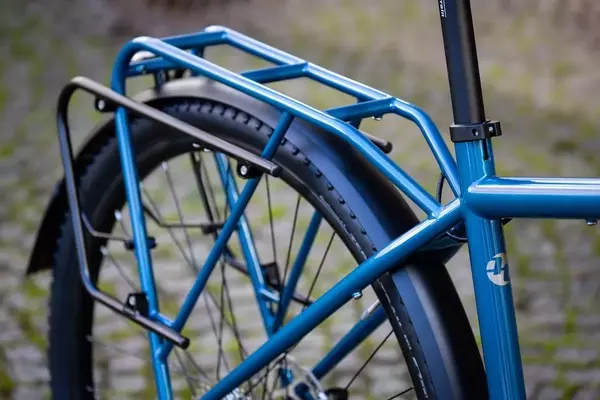
Tout Terrain Blueridge: The Ultimate Touring Bike for the TransAmerica Trail