Trending Searches
Van Rysel's RCR-XC: A Cross-Country Bike Challenging Conventions
Embrace the Future: Van Rysel RCR-XC Redefines Cross-Country Cycling
The Rise of Large Wheels and Aerodynamic Integration in XC Biking
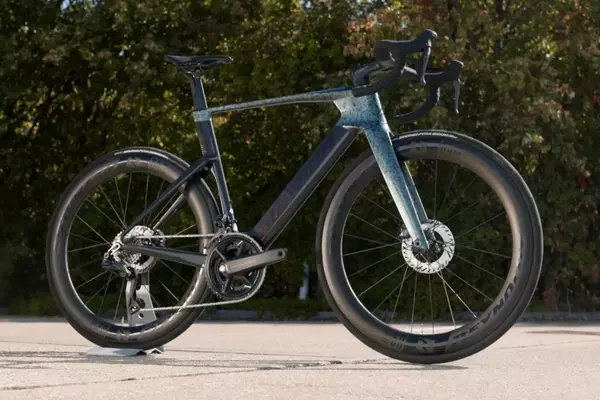
Earlier this year, Canyon introduced a conceptual cross-country bicycle that showcased features like 32-inch wheels, enhanced aerodynamics, and even a digital dashboard. This concept was perceived as a potential blueprint for future cross-country racing bikes. Now, Van Rysel's RCR-XC appears to be a realization of many of these predictions, incorporating similar design philosophies. It seems Van Rysel observed the mixed reactions to Canyon's prototype and decided to develop a bicycle that embraced these forward-thinking elements.
Addressing the Divisive Handlebar Design
The RCR-XC's handlebar design has been a particular point of contention. While visually unconventional, its functionality is rooted in engineering necessity. Larger front wheels necessitate a greater axle-to-crown measurement, which inherently elevates the bike's stack height. As observed with Revel's El Jeffe Grande, the increased length of the fork accommodating a 32-inch wheel imposes greater stress on the headtube. Consequently, a straightforward reduction in headtube length is not a viable solution. The RCR-XC's handlebar configuration provides the low front end crucial for climbing, a common requirement in elite cross-country racing where negative rise stems are frequently employed. The inclusion of flattened sections further contributes to aerodynamic efficiency.
Prioritizing Performance Over Conventional Aesthetics
While Van Rysel might have developed a more visually appealing solution, the primary objective of a race bike is performance, not mere aesthetics. Other designs, such as the system on BMC's prototype 32er, also prioritize function over form, demonstrating the engineering challenges involved in combining a taller stack with the low-front-end requirements of competitive cycling. The complexity of designing around a precise stem height, especially when compared to standard 29-inch wheel configurations, often necessitates innovative, albeit unconventional, solutions.
The Growing Influence of Aerodynamics in Cross-Country Racing
The integration of aerodynamic features into cross-country bikes, such as the RCR-XC, might seem unusual to some, but it represents a logical evolution in elite-level racing. Racers have already been experimenting with gravel tires and deep-section gravel rims in competitions, indicating a clear move towards optimizing speed. While these setups might not be practical for casual riders, they offer a significant competitive edge for professional athletes. Van Rysel's press release highlights that the RCR-XC offers a 15.5-watt saving at 35 km/h compared to current team bikes, underscoring the tangible benefits of its aerodynamic design.
Small Gains, Big Impact: The RCR-XC's Performance Philosophy
Even though average speeds in cross-country races are typically lower than 35 km/h, the principles of aerodynamics still yield advantages. Aerodynamic wheels, for instance, contribute to energy savings even at slower speeds. Given the increasingly competitive, technical, and fast-paced nature of modern cross-country racing, any marginal gain can be decisive. The RCR-XC, despite its unconventional appearance, signifies a progressive step in bike design, bringing a much-needed shake-up to a segment that some perceive as having stagnated. Its success in races would validate its purpose and design philosophy.
The Future of 32-Inch Wheels and Aerodynamic Cycling
The adoption of 32-inch wheels is gaining traction, with several brands embracing this trend. The author's personal experience suggests real-world applications for this wheel size. The year 2026 has seen big wheels achieve notable successes in events like the Cape Epic and national XC races, securing podium finishes for riders like Ondřej Cink, Alessandra Keller, and Nino Colombo. While these results do not definitively prove that big wheels are the future, they present compelling evidence for their potential. The widespread adoption of 32-inch wheels and aerodynamic kits in 2027 will ultimately determine if these innovations are here to stay or merely passing trend