Trending Searches
Orbea's Prototype Aero Bike: A Masterpiece of Disguise and Innovation
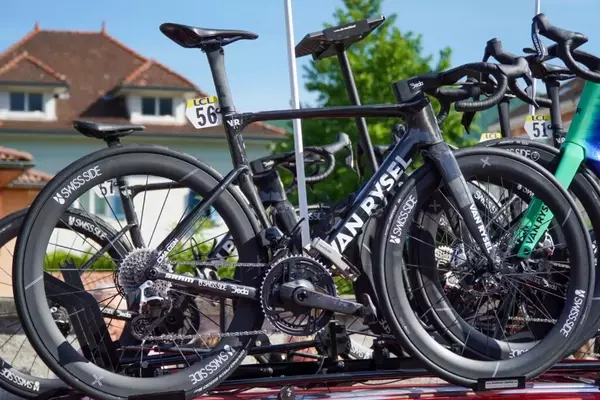
A new prototype aero bicycle from Orbea made its debut at the Tour Auvergne-Rhône-Alpes, a crucial precursor to the Tour de France. Designers intentionally obscured the frame's distinct aerodynamic characteristics with a hand-drawn pattern, creating a visual puzzle for observers. This strategic concealment, reminiscent of techniques used in the automotive industry, aims to deter competitors and media from fully deciphering the bike's innovations.
Despite the clever disguise, a detailed inspection uncovers several key design modifications. The fork's leading edge is notably deeper, suggesting Orbea has extended its profile forward of the front axle, a common strategy to enhance frontal aerodynamics. While major alterations to the headtube are not immediately apparent, subtle changes in contouring and a more gradual transition into the top tube hint at refined airflow. Perhaps the most surprising feature is the extended bottom bracket shell, which designers likely engineered to shield the rear wheel more effectively. Additionally, the new bike showcases a remarkably slender handlebar, a departure from the deeper sections often found on aero bikes, raising questions about its final configuration and potential impact on stiffness and comfort for professional riders. Furthermore, the prototype appears to offer enhanced tire clearance, accommodating 29mm Vittoria Corsa Pro tires on 23mm internal width Oquo rims, with potential for even wider 32mm or 33mm tires, signaling a trend towards greater versatility and comfort.
The removal of the storage box from the downtube, a feature on previous Orca Aero models, is a significant change. This box, originally designed to house essentials and improve aerodynamics, was ultimately banned by the UCI from professional races, prompting its omission from the prototype. The new design elements collectively represent Orbea's commitment to continuous improvement, pushing the boundaries of cycling technology to achieve superior performance and efficiency. The subtle yet impactful changes underscore the meticulous attention to detail required to gain a competitive edge in elite cycling.
The relentless pursuit of innovation in cycling technology showcases humanity's drive for excellence and efficiency. Each advancement, whether in aerodynamics or component design, reflects a dedication to optimizing performance and pushing the limits of what is possible. This spirit of innovation not only elevates the sport but also inspires us to embrace progress and strive for betterment in all aspects of life.